Custom Software
SaaS / Infrastructure

Zyvlon Infrastructure: A Control Plane for Multi-Tenant Commerce

Zyvlon (CrysoLabs product) · A monorepo platform with a hostname-routed storefront runtime, a manifest-driven site manager, a durable job queue, Dokploy deployment and a verified MongoDB → PostgreSQL migration.

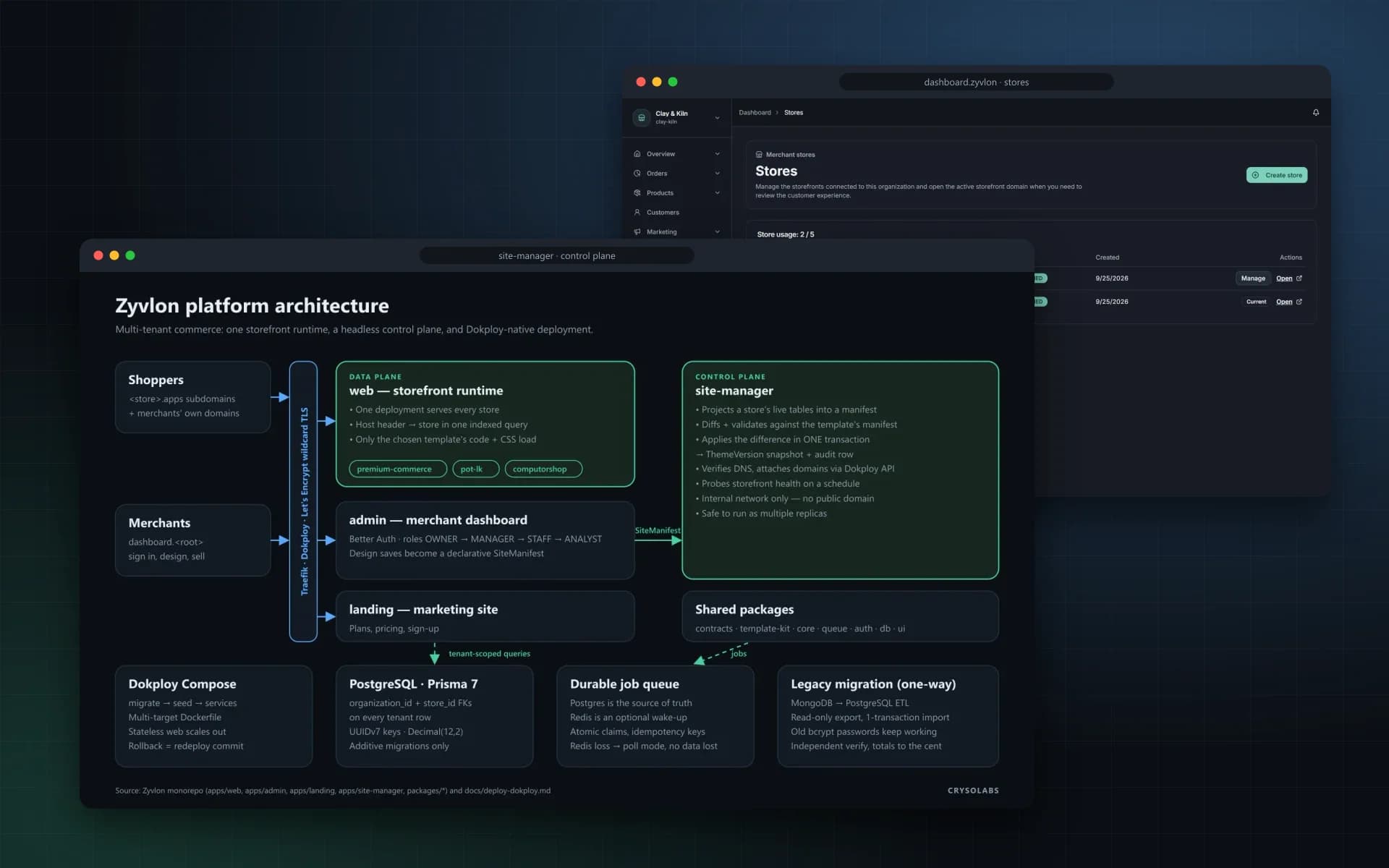
Zyvlon Infrastructure: A Control Plane for Multi-Tenant Commerce hero image

Client

Zyvlon (CrysoLabs product)

Timeline

Platform build, Sept 2026

Team

Small senior team

Scope

Monorepo · Control plane · Queue · Dokploy · Migration

The Challenge

Turn a single MongoDB app into a multi-tenant SaaS without losing a merchant, an order or a password.

Multi-tenancy is easy to promise and hard to keep. Every query must be scoped to the right store, a merchant's design change must never half-apply, custom domains need DNS checks and certificates, and background jobs cannot vanish when a cache restarts. The legacy MongoDB data also had to cross over without password resets.

Our Solution

Separate data and control planes, declarative site manifests, a Postgres-backed queue, one-file Dokploy deployment and a rehearsable, independently verified migration.

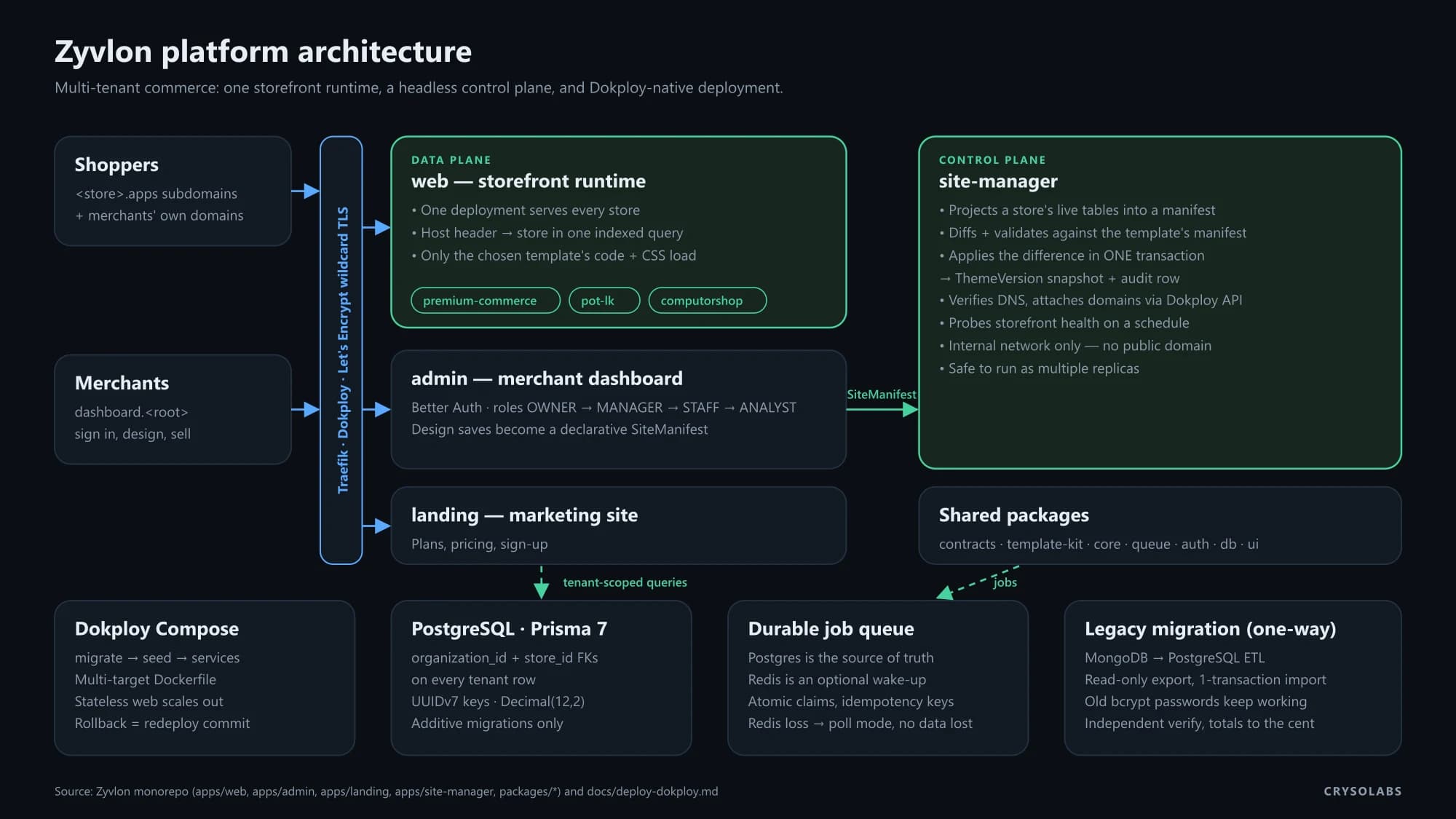
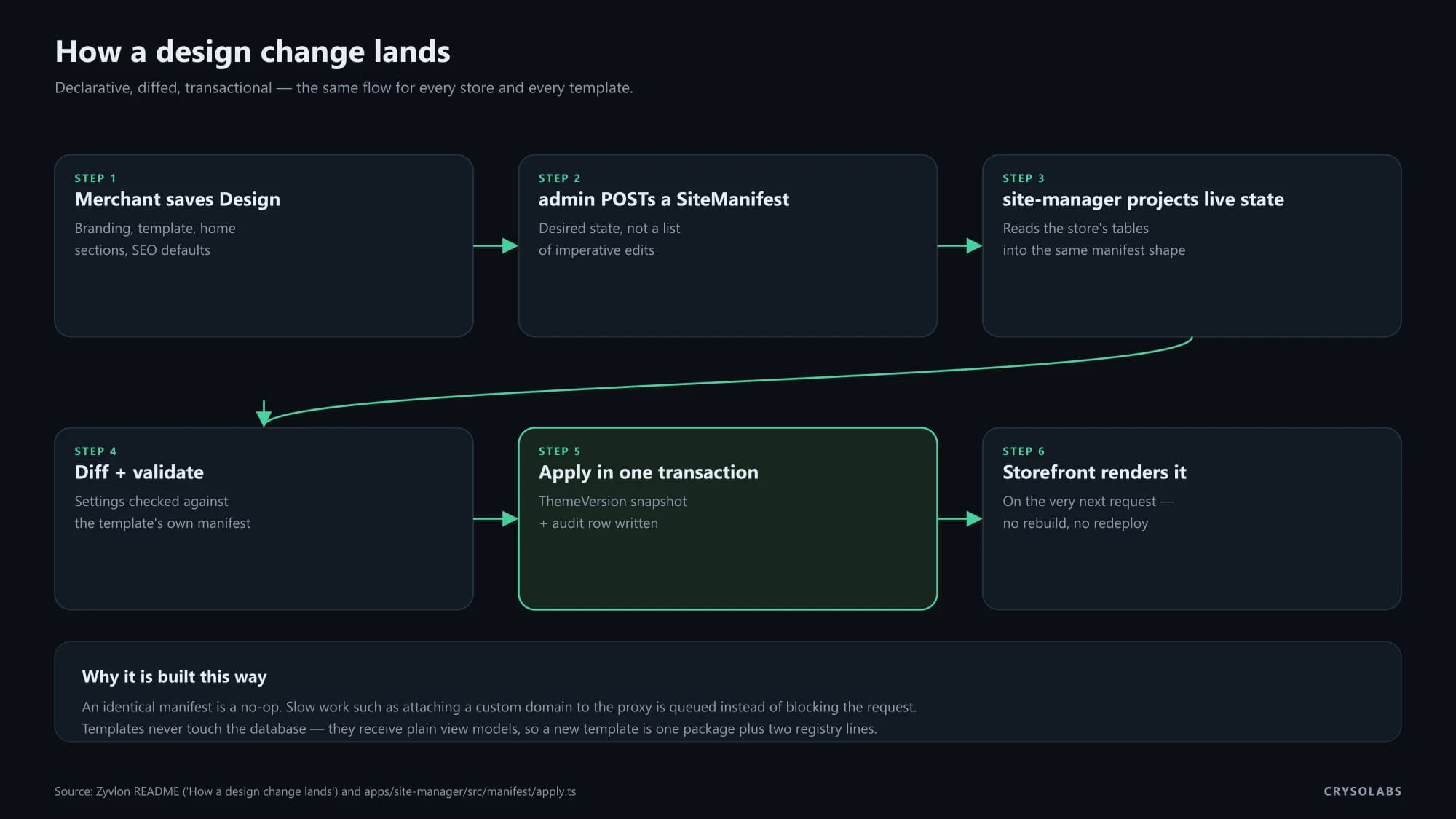
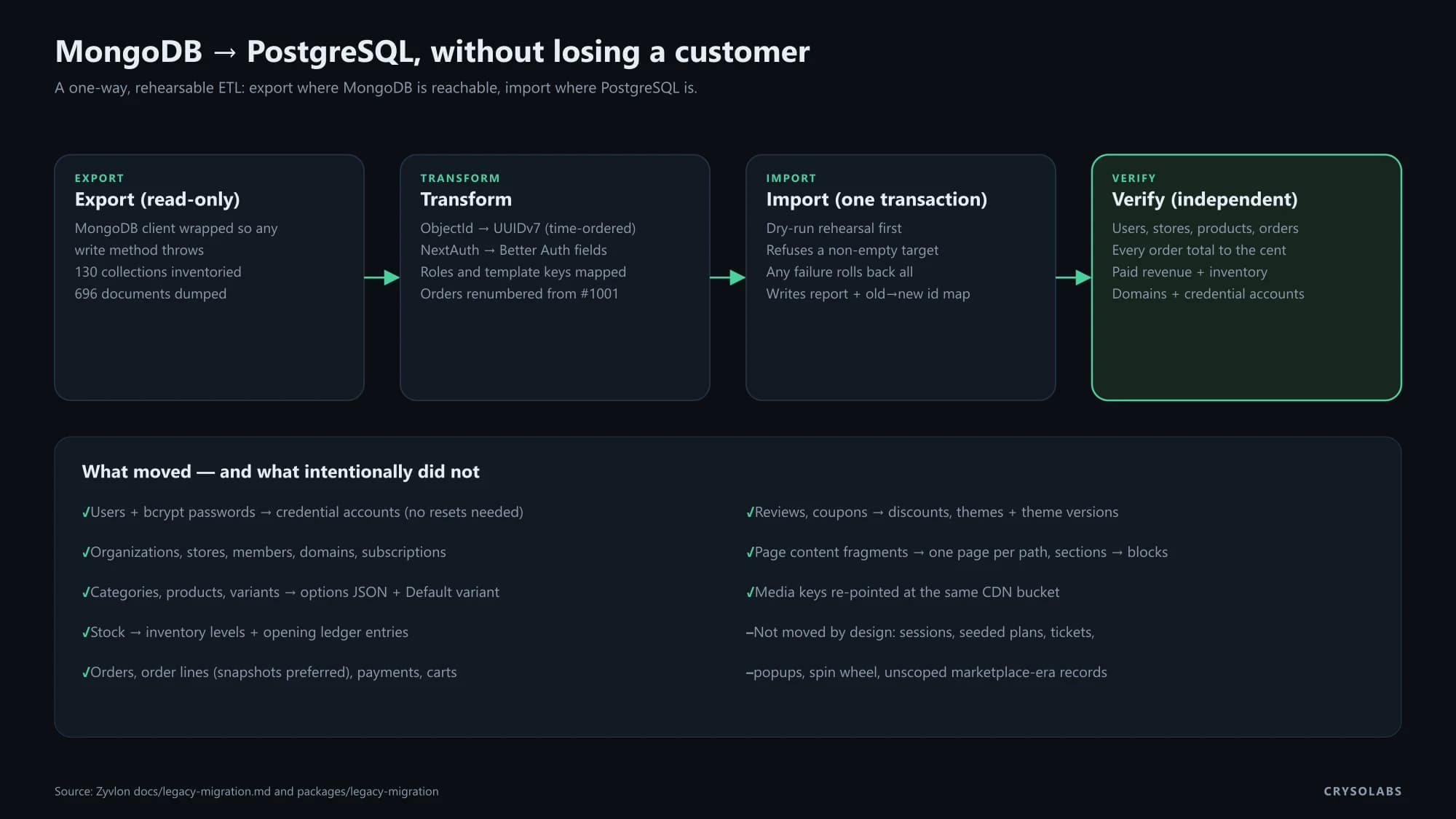
The web service resolves the store from the Host header in one indexed query and dynamically imports only that store's template. The admin never edits live tables directly: it posts a declarative SiteManifest to the site manager, which projects the store's current state, diffs and validates it against the template's own manifest, and applies the difference in one transaction with a ThemeVersion snapshot and audit row. Slow work, such as attaching a domain through the Dokploy API, goes to a durable queue where PostgreSQL is the truth and Redis only wakes workers. The legacy migration exports read-only (the Mongo client throws on any write), maps every model to the new schema with UUIDv7 ids derived from ObjectId timestamps, imports in a single transaction, and is checked by a separate verifier that compares counts, revenue, inventory and every order total to the cent.

Stack

TurborepoNext.js 16FastifyPrisma 7PostgreSQLRedisDockerDokploy
Platform proof points

The guarantees the platform is built on.

Organization and store foreign keys on every tenant row

Identical manifests are no-ops; changes are atomic and audited

Wildcard TLS for merchant subdomains via Traefik on Dokploy

Atomic job claims and idempotency keys for safe replicas

Read-only export, dry-run import rehearsal, one-transaction import

bcrypt passwords preserved; new accounts use scrypt

Architecture

Serve stores in one place, change them in another.

The web runtime only reads; the site manager is the only writer of design state. That split keeps storefronts fast and changes auditable.

Hostname → store in one query
Per-template code-splitting
Site manager on the internal network only

Operations

Dokploy-native from day one.

One Compose deployment runs migrations first, then the apps and Redis. Merchant subdomains share a wildcard certificate; custom domains get DNS verification and are attached automatically once the storefront service id is configured.

Migration

Rehearse until the verifier passes.

The ETL refuses to write into a database that already has tenant data, supports dry runs and store exclusions, writes a full report and an old-to-new id map, and leaves verification to an independent command.

Visual evidence

Architecture, change flow and migration.

Data plane and control plane

Data plane and control plane

Storefront runtime, dashboard and landing on one side; the site manager, queue and database behind them.

How a design change lands

How a design change lands

Manifest, projection, diff, validation and a single transaction, rendered on the next request.

MongoDB → PostgreSQL

MongoDB → PostgreSQL

Export, transform, import and an independent verifier before cut-over.

Business Result

New merchants, templates and domains no longer need new deployments, and legacy data moves across with verification to the cent.

The platform deploys from one Compose file, rolls back by redeploying a commit, and keeps working if Redis disappears. Merchants keep their existing passwords, and the storefront can be scaled out freely because it holds no state.

1
One stateless runtime serves every store by hostname
2
Design changes apply as audited, single-transaction manifests
3
Custom domains verified by DNS and attached via the Dokploy API
4
696 legacy documents from 130 collections exported read-only for migration
Accepting new engagements

Planning to turn your app into a platform?

Share a short brief. You'll get a written scope, a fixed quote, and a realistic timeline — usually within two business days.